Ratios de science Factorio : packs, SPM et goulots
Les ratios de science Factorio transforment un objectif de recherche en assembleuses, fonderies, pétrole, circuits, tapis et énergie. Partez des packs à maintenir et du SPM, puis vérifiez recette, laboratoires, transport et énergie au lieu de copier un nombre fixe.
Dernière mise à jour : 12 septembre 2026. Inclut la science classique, le SPM et des notes de planification pour Space Age.
Réponse rapide : que sont les ratios de science Factorio ?
Les ratios relient machines et ressources pour maintenir les packs à un débit cible. Planifiez en science par minute (SPM), puis remontez vers les intrants, les machines et le transport.
- Utilisez les ratios de science lorsque votre vraie question est de savoir comment maintenir 60, 100, 250 ou 1000 SPM.
- Le ratio de science classique n'est qu'un point de départ, car les modules, les niveaux d'assembleuses et la logistique de Space Age peuvent modifier le nombre exact de machines.
- Un plan de science échoue le plus souvent parce que le pétrole, les circuits, la fonderie ou le débit des tapis roulants prennent du retard par rapport aux assembleuses de packs de science visibles.
- Utilisez un calculateur en direct dès que la conception inclut des modules, des blocs sous balises, des niveaux de machines mixtes ou l'expédition interplanétaire de Space Age.
La planification de la science est un problème d'usine complet
Chaque SPM supplémentaire augmente la demande en amont. Une chaîne de pétrole, un circuit ou un tapis saturé peut arrêter les laboratoires malgré un ratio final correct.
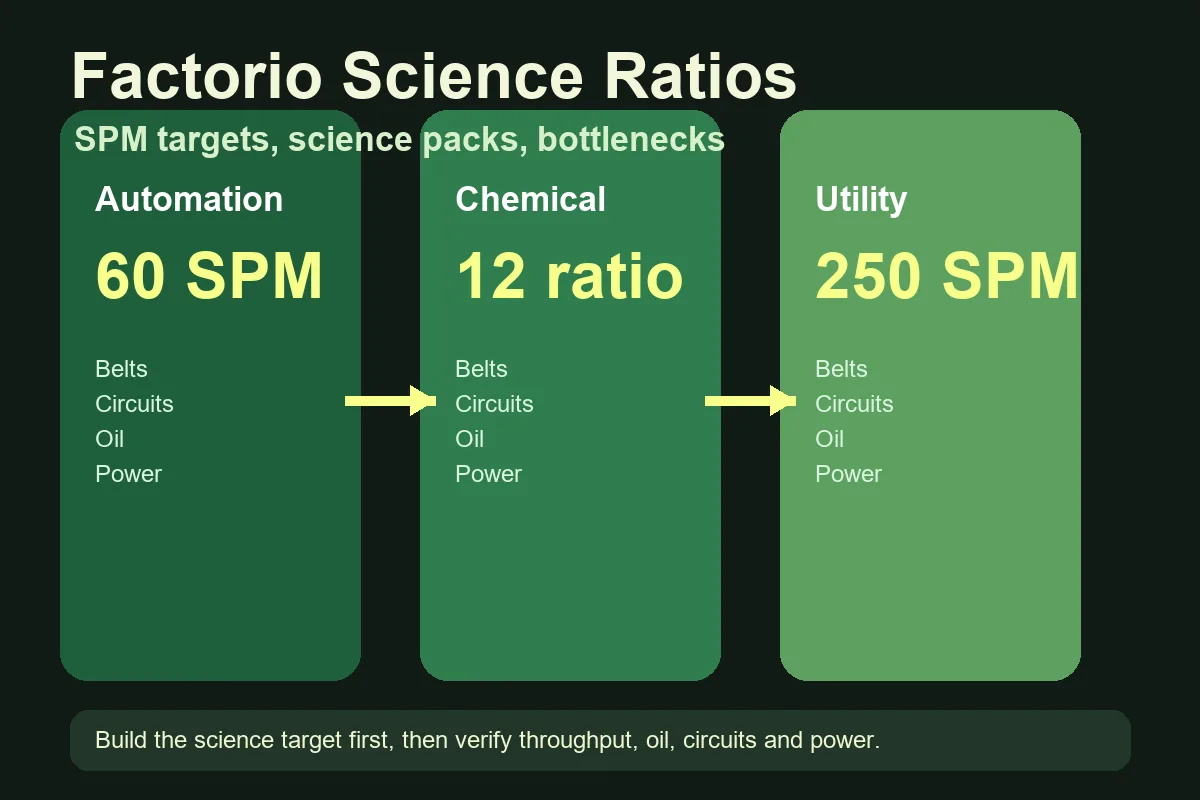
Commencez par un objectif de science, pas par un ratio mémorisé
Commencez par la vitesse de recherche. Le SPM relie l’objectif à l’échelle de l’usine et évite de copier un ratio hors contexte.
| Objectif | Usage typique | Impact sur la planification |
|---|---|---|
| 60 SPM | Progression confortable de la base principale | Assez petit pour des agencements propres basés sur des tapis roulants et un débogage facile. |
| 100-250 SPM | Montée en échelle structurée du milieu à la fin de partie | Le pétrole, les circuits, l'approvisionnement ferroviaire et l'électricité deviennent des contraintes plus visibles. |
| 500-1000 SPM | Grande base optimisée | L'usage des balises, le débit des trains, l'UPS et la conception logistique comptent plus que des ratios mémorisés. |
| SPM spécifique à chaque planète | Planification de l'extension Space Age | La production locale et le transport interplanétaire peuvent être le véritable goulot d'étranglement. |
Référence classique des ratios de Science Pack
Cette table donne une référence classique d’assembleurs synchronisés. Recalculez-la si les machines, modules ou règles de qualité changent.
| Science Pack | Ratio relatif | Ce qui devient généralement le premier goulot d'étranglement |
|---|---|---|
| Science automation | 5 | Généralement simple ; les engrenages et le cuivre ne posent pas de difficulté. |
| Science logistic | 6 | Les bras robotisés et les tapis roulants augmentent tôt la pression sur le fer. |
| Science militaire | 5 | Les grenades, les murs et les munitions perforantes peuvent fausser le timing. |
| Science chimique | 12 | Le traitement du pétrole et la mise en place du soufre/plastique bloquent généralement la progression. |
| Science de production | 7 | Les rails, les fours et les modules de productivité augmentent fortement la demande. |
| Science utilitaire | 7 | Les circuits bleus, les LDS et les structures de robots volants sollicitent plusieurs systèmes à la fois. |
Exemple de ratio de science verte pour 60 SPM
Pour la science verte, 60 SPM équivaut à un pack par seconde. Avec une machine d’assemblage 2 sans modules, huit assembleuses finales suffisent ; vérifiez aussi bras et tapis.
| Étape de planification | Objectif 60 SPM | À vérifier |
|---|---|---|
| Production finale de packs | 1 pack de science logistique/s | Utilisez la vitesse de fabrication effective du niveau d'assembleuse choisi. |
| Nombre d'assembleuses finales | 8 machines d'assemblage 2 | Recalculez après l'ajout de modules, de balises ou de niveaux de machines mixtes. |
| Ingrédients directs | 1 bras robotisé/s et 1 convoyeur/s | Vérifiez l'approvisionnement partagé en engrenages et en fer avant de copier ce bloc. |
| Marge de capacité de transport | Plus que la moyenne exacte | Les pénuries viennent souvent d'une demande irrégulière du mall ou d'un chargement inégal des tapis. |
Workflow recommandé pour planifier le SPM
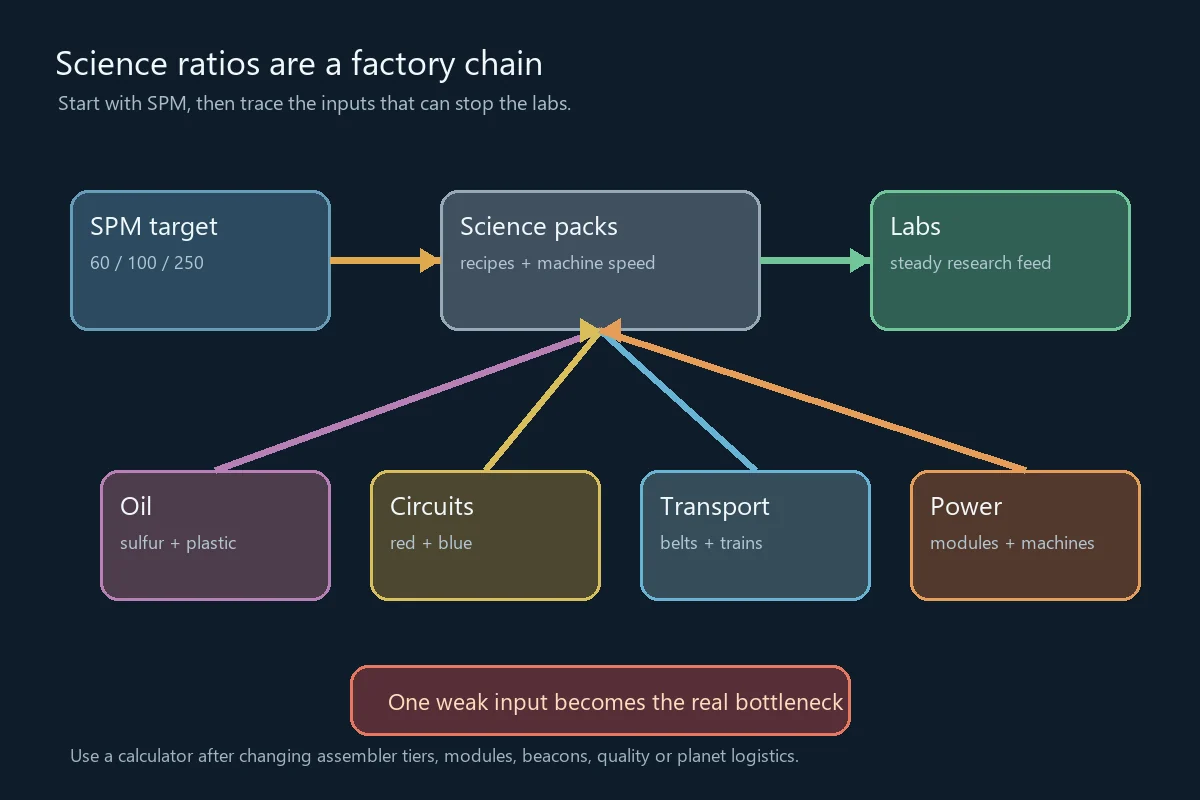
Choisissez un seul objectif de SPM
Définissez un objectif clair, comme 60, 120 ou 250 science par minute, avant de placer des machines.
Décomposez la science en systèmes en amont
Séparez la fonderie, les circuits, le pétrole, les low density structures, les robot frames et les modules pour rendre visibles les vrais points de pression.
Vérifiez le nombre de machines et la vitesse de fabrication
Le niveau des assembleurs et le choix des modules peuvent modifier suffisamment la production de science pour qu'un tableau statique devienne inexact.
Vérifiez les tapis, tuyaux et trains
Beaucoup de conceptions de science échouent parce que le débit et la livraison ne suivent pas les calculs de recettes pourtant propres.
Recalculez après avoir ajouté des modules ou des systèmes Space Age
La productivité, les beacons, la quality et le transport interplanétaire modifient tous le plan de science effectif.
Là où les bases de science cassent habituellement
Sous-dimensionnement du pétrole
La science chimique, les blue circuits et les packs de fin de partie échouent souvent parce que les raffineries, le cracking et le soutien en pétrole sont trop limités.
Pénuries de circuits
Les red circuits et les blue circuits deviennent des dépendances partagées entre plusieurs packs et couches d'infrastructure.
Saturation du transport
Un ratio de science correct échoue quand même si les tapis, trains, inserters ou bots ne peuvent pas soutenir le flux d'objets.
Retard de puissance
Les extensions de science semblent souvent correctes jusqu'à ce que les modules, roboports et la fonderie poussent le réseau vers des baisses de tension.
Exemples de packs de science du début de partie
La science verte et rouge illustre la planification SPM. Gardez ces exemples ici, car ils décrivent le même flux de production.
| Pack | Note de planification de départ | Quand recalculer |
|---|---|---|
| Automation science | Assez simple à dimensionner à partir des engrenages et des plaques de cuivre. | Lorsque les niveaux d'assembleurs ou les modules diffèrent. |
| Science logistique / verte | Les tapis et les bras robotisés augmentent tôt la pression sur le fer. | Lorsque la production de tapis alimente aussi un mall ou une extension. |
| Military science | Les grenades et les munitions peuvent casser un ratio propre. | Lorsque la demande de défense partage les mêmes ingrédients. |
| Chemical science | L'installation pétrolière devient généralement le vrai goulot d'étranglement. | Lorsque le pétrole, le soufre ou le plastique s'accumulent. |
Les ratios de science de Space Age demandent plus que des tableaux statiques
Space Age ajoute recettes planétaires, logistique, qualité et plateformes. Calculez la chaîne locale, puis validez le transport et l’approvisionnement.
| Facteur Space Age | Pourquoi cela change les calculs de science | Meilleure habitude de planification |
|---|---|---|
| Recettes propres à chaque planète | Chaque chaîne de science peut dépendre d'un environnement de production différent. | Résolvez d'abord la chaîne locale, puis ajoutez le transport. |
| Fusées cargo et plateformes | Le délai de livraison peut limiter la science avant même le débit des recettes. | Convertissez la demande de packs en cadence d'expédition. |
| Modules de qualité | Les rendements basés sur la probabilité modifient les besoins en machines. | Planifiez les objectifs de qualité séparément de la science de base. |
| Différences de puissance | Une alimentation faible ou instable peut brider une chaîne scientifique complète. | Vérifiez l'alimentation locale avant d'augmenter le nombre de labos. |
Besoin d'un nombre exact de machines pour la science ?
Utilisez le calculateur Factorio en direct pour convertir vos objectifs SPM en assembleurs, intrants, tapis, modules et besoins en énergie, puis utilisez cette page pour vérifier les points faibles.
Questions fréquentes sur les ratios de science Factorio
Quel est le ratio scientifique classique dans Factorio ?
Une référence classique courante est 5:6:5:12:7:7 pour la science d'automatisation, logistique, militaire, chimique, de production et d'utilité. Considérez-la comme un guide rapide, pas comme une construction exacte universelle.
Dois-je planifier la science par ratios ou par SPM ?
Planifiez d’abord selon le SPM. Les ratios aident à expliquer les relations, mais la science par minute est l’objectif de construction le plus clair pour les machines, le transport et l’énergie.
Pourquoi mon installation de science se bloque-t-elle même quand le ratio semble correct ?
Les causes habituelles sont des pénuries de pétrole, des goulots d’étranglement en circuits rouges ou bleus, des tapis saturés, des retards de train, une puissance insuffisante ou des changements de modules qui n’ont pas été recalculés.
Les modules modifient-ils les ratios de science dans Factorio ?
Oui. Les modules de productivité, les modules de vitesse et les effets des balises modifient la production effective et la demande en ingrédients, donc le nombre de machines doit être recalculé.
Est-ce que Space Age change la planification des ratios de science ?
Oui. Space Age ajoute des planètes, un rythme logistique, des systèmes de qualité et de nouvelles dépendances, donc un tableau de science statique ne devient qu’un point de départ.
Quel est le ratio de science verte dans Factorio ?
La science verte dépend des bras et des tapis. Partez du SPM et vérifiez fer, engrenages et belts si un mall utilise les mêmes ressources.
Combien d’assembleurs me faut-il pour 60 SPM de science verte ?
Avec une machine d’assemblage 2, une recette de six secondes et aucun module, huit assembleuses produisent 60 sciences par minute. Recalculez après toute modification de vitesse ou productivité.
Quel est le ratio de science bleue dans Factorio ?
Il n’existe pas un nombre universel pour la science bleue. Partez du SPM, calculez soufre, moteurs et circuits rouges, puis vérifiez pétrole et tapis.
Comment calculer les ratios de science de Factorio pour un objectif de 60 SPM ?
Fixez 60 sciences par minute, calculez les assembleuses des packs, puis remontez jusqu’aux labos, tapis, pétrole, circuits et énergie. Les machines, modules, balises et la logistique Space Age changent le total.
Sources et lectures complémentaires
Ces références aident à vérifier les données des packs de science, les relations entre recettes et le comportement du calculateur.