Proporções de ciência Factorio: packs, SPM e gargalos
As proporções de ciência de Factorio ajudam você a transformar uma meta de pesquisa em montadoras, fornos, produtos de petróleo, circuitos, correias e energia. Use esta página quando você souber quais science packs quer sustentar, mas precisar de um modelo de planejamento mais claro do que anotações dispersas da wiki ou uma única folha de consulta estática. Para ciência azul ou verde, comece pela meta de SPM e confirme receita, consumo dos laboratórios, carga das esteiras e energia em vez de copiar uma quantidade fixa de máquinas.
Última atualização: 12 de setembro de 2026. Inclui ciência clássica, SPM e notas de planejamento do Space Age.
Resposta Rápida: O Que São as Proporções de Ciência de Factorio?
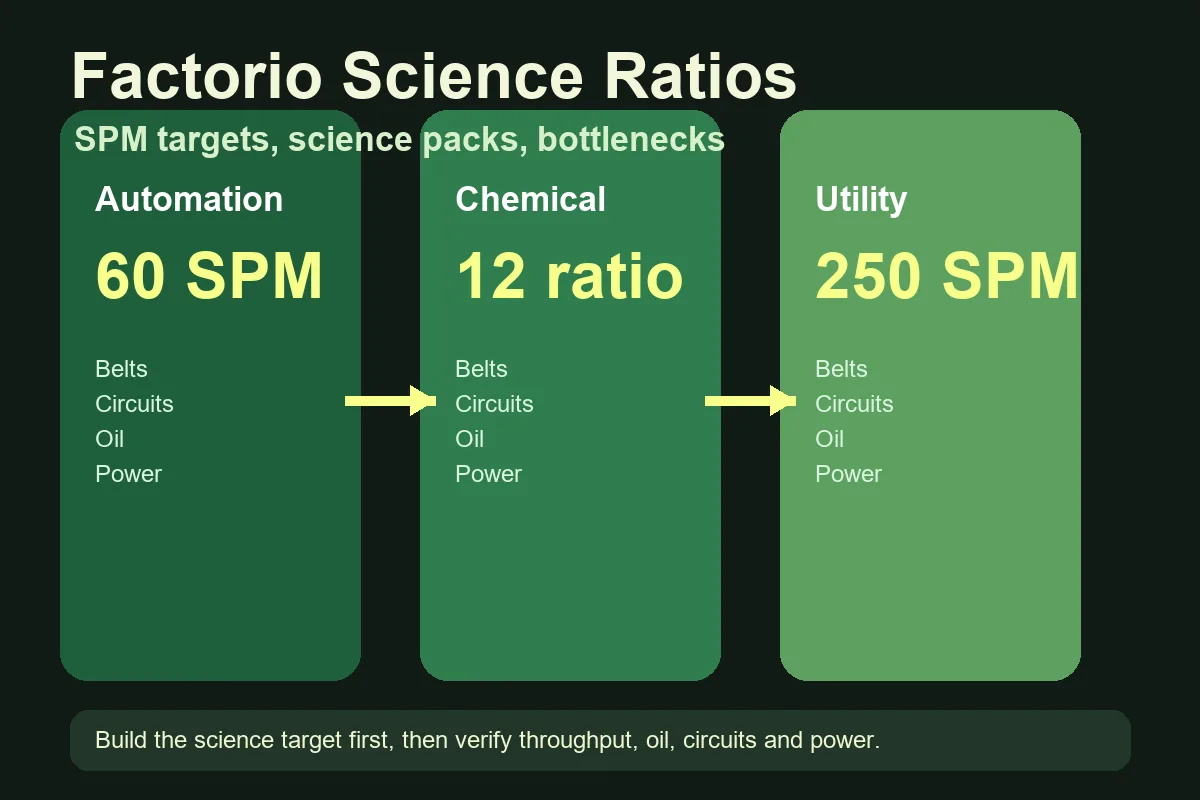
As proporções de ciência são as relações entre máquinas e recursos necessárias para manter os science packs fluindo em uma taxa alvo. Na prática, a maioria dos jogadores planeja a ciência por science per minute (SPM) e depois retrocede para insumos, quantidades de máquinas e limites de transporte.
- Use proporções de ciência quando sua verdadeira pergunta for como sustentar 60, 100, 250 ou 1000 SPM.
- A proporção clássica de ciência é apenas um ponto de partida, porque módulos, níveis de montadoras e a logística de Space Age podem alterar as quantidades exatas de máquinas.
- Um plano de ciência falha com mais frequência porque petróleo, circuitos, fundição ou vazão das correias ficam para trás em relação às montadoras visíveis de science packs.
- Use uma calculadora em tempo real quando o projeto incluir módulos, blocos com beacons, níveis mistos de máquinas ou envio entre planetas em Space Age.
Planejar Ciência É um Problema da Fábrica Inteira
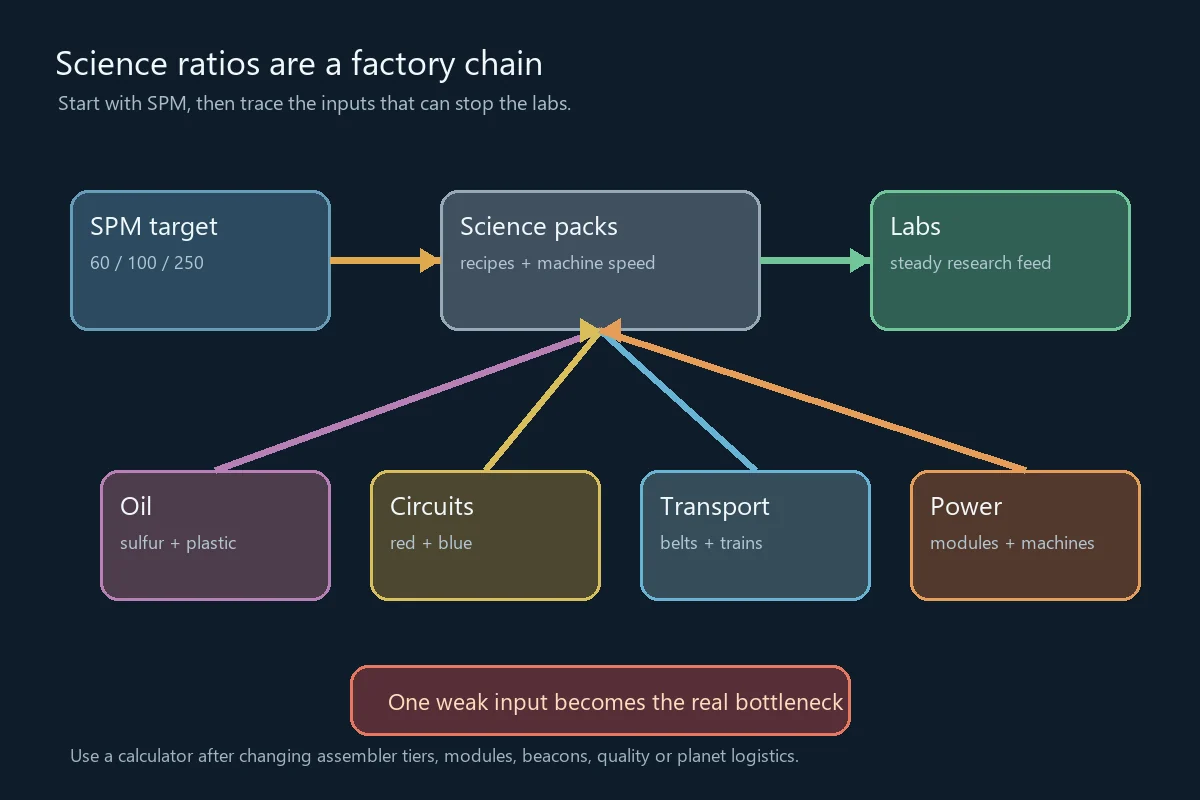
Uma meta de ciência parece simples no papel, mas cada SPM extra multiplica a demanda a montante. Uma cadeia de petróleo ausente, falta de red circuits ou uma correia saturada podem quebrar toda a alimentação dos laboratórios mesmo quando a proporção final de ciência parece correta.
Comece com uma Meta de Ciência, Não com uma Proporção Decorada
A pergunta certa de planejamento não é apenas “qual é a proporção”, mas “que velocidade de pesquisa eu quero sustentar?” SPM é o ponto de decisão mais claro porque corresponde à forma como os jogadores dimensionam a fábrica.
| Meta | Uso típico | Impacto no planejamento |
|---|---|---|
| 60 SPM | Progressão confortável da base principal | Pequeno o bastante para layouts limpos baseados em belts e depuração fácil. |
| 100-250 SPM | Escalonamento estruturado do meio para o fim do jogo | Petróleo, circuitos, suprimento ferroviário e energia passam a ser limitações mais visíveis. |
| 500-1000 SPM | Base grande e otimizada | Beaconing, vazão dos trens, UPS e o projeto da logística importam mais do que proporções decoradas. |
| SPM específico por planeta | Planejamento da expansão Space Age | A produção local e o transporte interplanetário podem ser o verdadeiro gargalo. |
Referência clássica de proporção de Science Packs
Para o conjunto clássico de ciência anterior ao Space Age, abaixo está uma proporção comum e sincronizada de montadoras. Ela é útil como cola, mas apenas quando as premissas das máquinas usadas permanecem consistentes.
| Science Pack | Proporção relativa | O que costuma virar gargalo primeiro |
|---|---|---|
| Automation science | 5 | Geralmente é fácil; engrenagens e cobre são simples. |
| Logistic science | 6 | Inserters e belts aumentam a pressão inicial sobre o ferro. |
| Ciência militar | 5 | Granadas, muros e munição perfurante podem alterar o timing. |
| Ciência química | 12 | O processamento de petróleo e a configuração de enxofre/plástico geralmente limitam o progresso. |
| Ciência de produção | 7 | Trilhos, fornos e módulos de produtividade aumentam bastante a demanda. |
| Ciência de utilidade | 7 | Circuitos azuis, LDS e estruturas de robôs voadores sobrecarregam vários sistemas ao mesmo tempo. |
Exemplo de proporção de ciência verde para 60 SPM
Para uma verificação concreta de ciência logística, 60 SPM equivale a um logistic science pack por segundo. Com assembling machine 2 e sem módulos, a receita de seis segundos precisa de oito montadoras finais; essas montadoras também exigem, no total, um inserter e uma transport belt por segundo.
| Etapa de planejamento | Meta de 60 SPM | O que verificar |
|---|---|---|
| Produção final de packs | 1 pacote de ciência logística/s | Use a velocidade efetiva de fabricação do nível de montadora escolhido. |
| Montadoras finais | 8 assembling machine 2 | Recalcule após módulos, beacons ou níveis mistos de máquinas. |
| Ingredientes diretos | 1 inserter/s e 1 transport belt/s | Verifique o suprimento compartilhado de engrenagens e ferro antes de copiar o bloco. |
| Margem no transporte | Mais do que a média exata | As faltas geralmente vêm da demanda em rajadas do mall ou do carregamento desigual das correias. |
Fluxo de trabalho recomendado para planejamento de SPM
Escolha uma meta única de SPM
Defina uma meta clara, como 60, 120 ou 250 science por minuto, antes de posicionar as máquinas.
Divida a science em sistemas anteriores da cadeia
Separe fundição, circuitos, petróleo, low density structures, robot frames e modules para que os verdadeiros pontos de pressão fiquem visíveis.
Verifique a contagem de máquinas e a velocidade de produção
O nível dos assemblers e a escolha de modules podem alterar a produção de science o suficiente para que uma tabela estática fique imprecisa.
Verifique correias, tubos e trens
Muitos designs de science falham porque a vazão e a entrega ficam atrás da matemática limpa das receitas.
Recalcule após adicionar modules ou sistemas de Space Age
Produtividade, beacons, quality e transporte interplanetário mudam o plano efetivo de science.
Onde as bases de science costumam falhar
Subdimensionamento de petróleo
Chemical science, blue circuits e packs de fim de jogo costumam falhar porque refinarias, cracking e suporte de petroleum são pequenos demais.
Falta de circuitos
Red circuits e blue circuits se tornam dependências compartilhadas entre vários packs e camadas de infraestrutura.
Saturação do transporte
Uma proporção correta de science ainda falha quando correias, trens, inserters ou bots não conseguem sustentar o fluxo de itens.
Atraso de energia
Expansões de science muitas vezes parecem corretas até que modules, roboports e fundição levem a rede a quedas de tensão.
Exemplos de Science Pack iniciais
A demanda de busca inclui proporções de green science e proporções de red science. Mantenha esses exemplos dentro desta página de science, porque eles ajudam no planejamento de SPM em vez de exigirem páginas separadas.
| Pack | Nota de planejamento inicial | Quando recalcular |
|---|---|---|
| Automation science | Simples o bastante para dimensionar a partir de engrenagens e placas de cobre. | Quando os níveis de montadoras ou os módulos forem diferentes. |
| Ciência logística / verde | Esteiras e inserters aumentam cedo a pressão sobre o ferro. | Quando a produção de esteiras também abastece um mall ou uma expansão. |
| Military science | Granadas e munição podem atrapalhar uma proporção limpa. | Quando a demanda de defesa compartilha os mesmos ingredientes. |
| Chemical science | A configuração de petróleo normalmente vira o verdadeiro gargalo. | Quando petroleum, sulfur ou plastic acumulam. |
As proporções de science em Space Age exigem mais do que tabelas estáticas
Space Age muda o planejamento de science porque a questão deixa de ser apenas quantas montadoras produzem cada pack. Receitas específicas de cada planeta, cadência logística, decisões de qualidade e abastecimento de plataforma podem redefinir a proporção efetiva.
| Fator de Space Age | Por que isso muda a matemática de science | Melhor hábito de planejamento |
|---|---|---|
| Receitas específicas de cada planeta | Cada cadeia de science pode depender de um ambiente de produção diferente. | Resolva primeiro a cadeia local e depois adicione o transporte. |
| Foguetes de carga e plataformas | O tempo de entrega pode limitar a ciência antes da produção da receita. | Converta a demanda de packs na cadência de envios. |
| Módulos de qualidade | Resultados baseados em probabilidade alteram os requisitos das máquinas. | Planeje as metas de qualidade separadamente da ciência base. |
| Diferenças de energia | Energia fraca ou instável pode limitar uma cadeia completa de ciência. | Verifique a energia local antes de expandir os laboratórios. |
Precisa de contagens exatas de máquinas de ciência?
Use a calculadora ao vivo de Factorio para transformar metas de SPM em montadoras, insumos, correias, módulos e requisitos de energia, e depois use esta página para validar os pontos fracos.
Perguntas frequentes sobre proporções de ciência do Factorio
Qual é a proporção clássica de ciência em Factorio?
Uma referência clássica comum é 5:6:5:12:7:7 para ciência de automação, logística, militar, química, produção e utilidade. Trate isso como um guia rápido, não como uma construção universal e exata.
Devo planejar a ciência por proporções ou por SPM?
Planeje por SPM primeiro. As proporções ajudam a explicar as relações, mas ciência por minuto é a meta de construção mais clara para máquinas, transporte e energia.
Por que minha configuração de ciência trava mesmo quando a proporção parece correta?
As causas mais comuns são falta de petróleo, gargalos em circuitos vermelhos ou azuis, esteiras saturadas, atrasos de trem, energia insuficiente ou mudanças em módulos que não foram recalculadas.
Os módulos alteram as proporções de ciência no Factorio?
Sim. Módulos de produtividade, módulos de velocidade e efeitos de beacon alteram a produção efetiva e a demanda de ingredientes, então a quantidade de máquinas deve ser recalculada.
Space Age muda o planejamento das proporções de ciência?
Sim. Space Age adiciona planetas, cadência logística, sistemas de qualidade e novas dependências, então uma tabela de ciência estática passa a ser apenas um ponto de partida.
Qual é a proporção de ciência verde no Factorio?
A ciência verde depende do fornecimento de inserter e transport belt, então a resposta útil para planejamento não é apenas uma contagem final de montadoras. Dimensione a ciência logística a partir da sua meta de SPM e depois verifique se placas de ferro, engrenagens e a produção de esteiras também estão abastecendo um mall ou uma expansão.
De quantas montadoras eu preciso para 60 SPM de ciência verde?
Com assembling machine 2, a receita normal de ciência logística de seis segundos e sem módulos, use oito montadoras finais para 60 de ciência por minuto. Recalcule se a velocidade de produção, a produtividade, o comportamento da receita ou a logística de Space Age mudarem as premissas.
Qual é a proporção de ciência azul no Factorio?
Ela depende da meta de SPM e do nível dos montadores, portanto não existe uma quantidade universal de máquinas. Comece pela ciência azul por minuto, calcule enxofre, motores e circuitos avançados e confira petróleo e capacidade das esteiras.
Como calculo as proporções de ciência do Factorio para uma meta de 60 SPM?
Defina 60 unidades de ciência por minuto como meta, calcule as montadoras dos packs finais e acompanhe cada receita até laboratórios, esteiras, petróleo, circuitos e energia. A quantidade exata depende da versão da receita, do nível das máquinas, dos módulos, dos beacons e da logística do Space Age.
Fontes e Leitura Adicional
Estas referências ajudam a verificar os dados dos pacotes de ciência, as relações entre receitas e o comportamento da calculadora.