Factorio Science Ratios: Packs, SPM & Bottlenecks
Factorio science ratios help you translate a research goal into assemblers, smelters, oil products, circuits, belts and power. Use this page when you know the science packs you want to sustain, but need a cleaner planning model than scattered wiki notes or a single static cheat sheet. For blue or green science, start from the SPM target, then verify the pack recipe, lab demand, belt load and power instead of copying one static machine count.
Last updated: September 12, 2026. Includes classic science, SPM and Space Age planning notes.
Quick Answer: What Are Factorio Science Ratios?
Science ratios are the machine and resource relationships needed to keep science packs flowing at a target rate. In practice, most players plan science by science per minute (SPM), then work backward into inputs, machine counts and transport limits.
- Use science ratios when your real question is how to sustain 60, 100, 250 or 1000 SPM.
- The classic science ratio is only a starting point, because modules, assembler tiers and Space Age logistics can change the exact machine counts.
- A science plan fails most often because oil, circuits, smelting or belt throughput lags behind the visible science pack assemblers.
- Use a live calculator once the design includes modules, beaconed blocks, mixed machine tiers or Space Age planet shipping.
Science Planning Is a Full Factory Problem
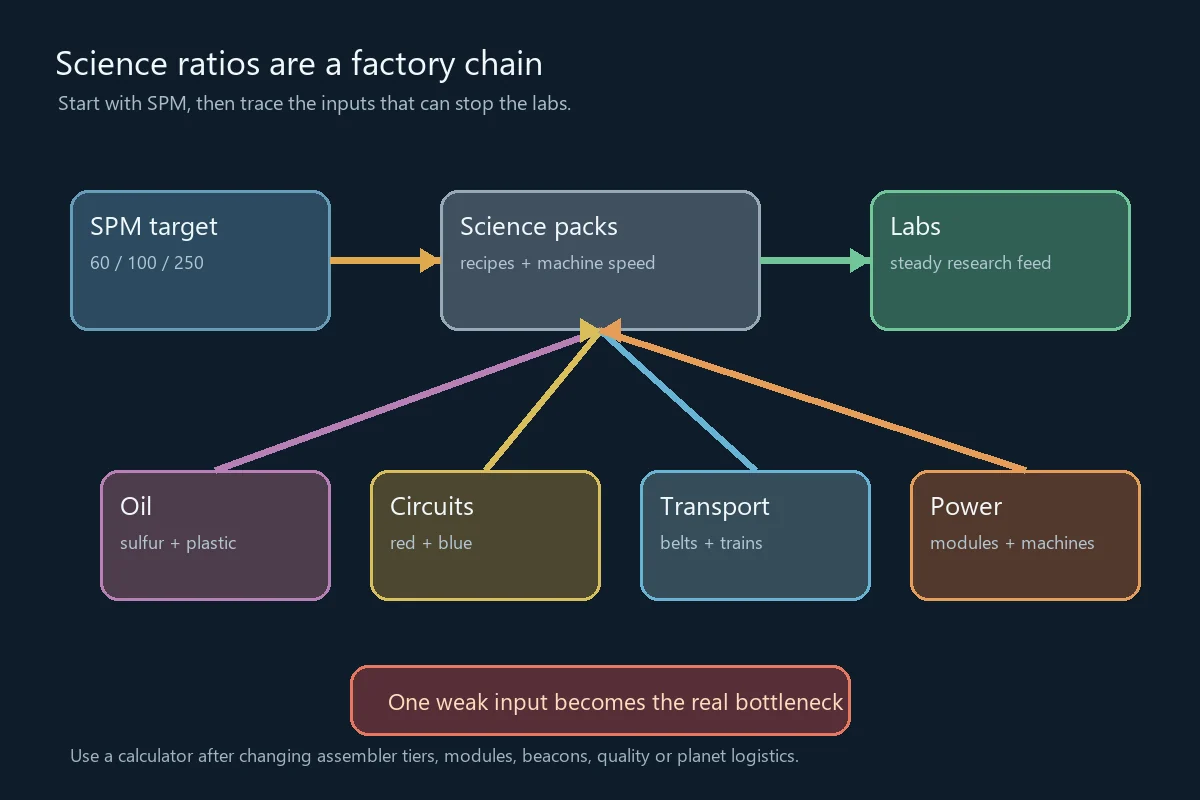
A science target looks simple on paper, but each extra SPM multiplies upstream demand. One missing oil chain, a red-circuit shortfall or a saturated belt can break the entire lab feed even when the final science ratio looks correct.
Start With a Science Goal, Not a Memorized Ratio
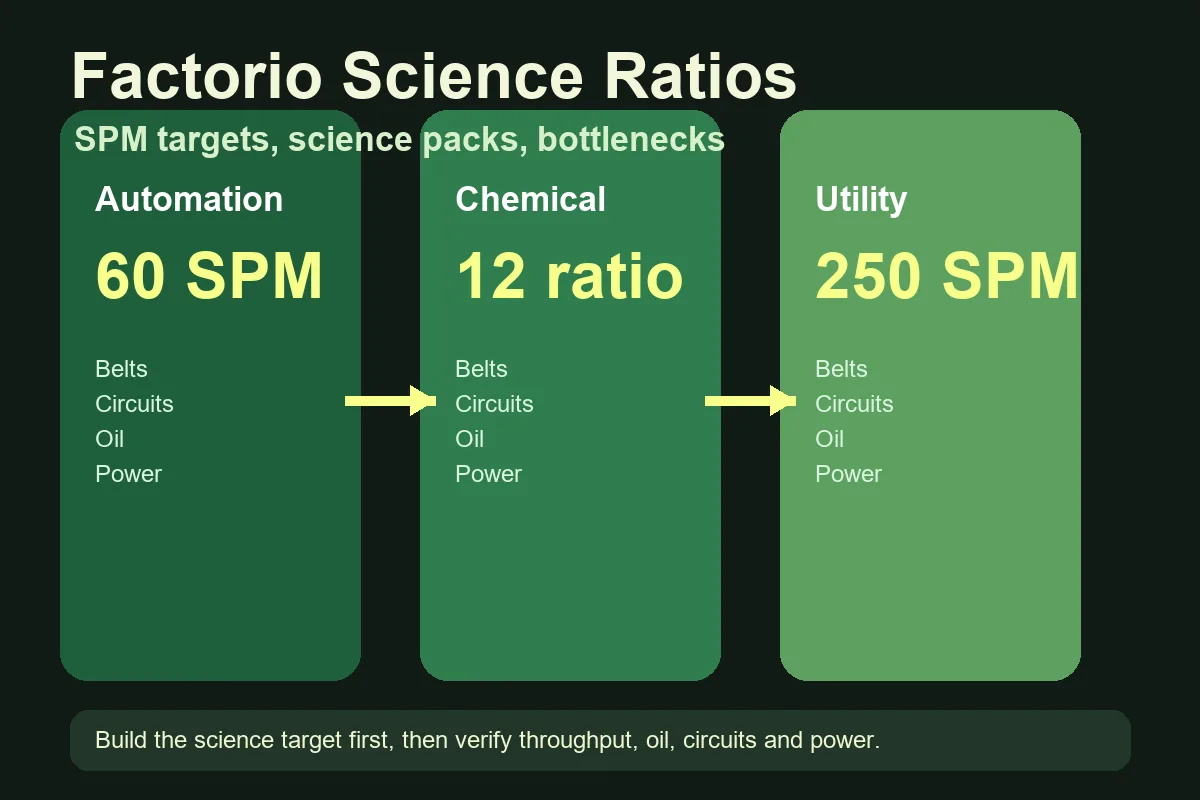
The right planning question is not only “what is the ratio,” but “what research speed do I want to sustain?” SPM is the cleaner decision point because it matches how players budget factory scale.
| Target | Typical Use | Planning Impact |
|---|---|---|
| 60 SPM | Comfortable main-base progression | Small enough for clean belt-based layouts and easy debugging. |
| 100-250 SPM | Structured mid/late-game scaling | Oil, circuits, rail supply and power become more visible constraints. |
| 500-1000 SPM | Large optimized base | Beaconing, train throughput, UPS and logistics design matter more than memorized ratios. |
| Planet-specific SPM | Space Age expansion planning | Local production and interplanetary shipping can be the real bottleneck. |
Classic Science Pack Ratio Reference
For the classic pre-Space-Age science set, a common synchronized assembler ratio is shown below. It is useful as a cheat sheet, but only when the underlying machine assumptions remain consistent.
| Science Pack | Relative Ratio | What Usually Bottlenecks First |
|---|---|---|
| Automation science | 5 | Usually easy; gears and copper are simple. |
| Logistic science | 6 | Inserters and belts raise early iron pressure. |
| Military science | 5 | Grenades, walls and piercing ammo can skew timing. |
| Chemical science | 12 | Oil processing and sulfur/plastic setup usually gate progress. |
| Production science | 7 | Rails, furnaces and productivity modules add bulk demand. |
| Utility science | 7 | Blue circuits, LDS and flying robot frames stress multiple systems at once. |
Green Science Ratio Example for 60 SPM
For a concrete logistic science check, 60 SPM equals one green science pack per second. With assembling machine 2 and no modules, the six-second recipe needs eight final assemblers; those assemblers also require one inserter and one transport belt per second in total.
| Planning step | 60 SPM target | What to verify |
|---|---|---|
| Final pack output | 1 logistic science pack/s | Use the effective crafting speed of the chosen assembler tier. |
| Final assemblers | 8 assembling machine 2 | Recalculate after modules, beacons or mixed machine tiers. |
| Direct ingredients | 1 inserter/s and 1 transport belt/s | Check shared gear and iron supply before copying the block. |
| Transport headroom | More than the exact average | Shortages often come from bursty mall demand or uneven belt loading. |
Recommended SPM Planning Workflow
Choose one SPM target
Pick a clear target such as 60, 120 or 250 science per minute before placing machines.
Break science into upstream systems
Separate smelting, circuits, oil, low density structures, robot frames and modules so the real pressure points are visible.
Check machine counts and crafting speed
Assembler tier and module choice can change science output enough that a static table becomes inaccurate.
Check belts, pipes and trains
Many science designs fail because throughput and delivery lag behind the clean recipe math.
Recalculate after adding modules or Space Age systems
Productivity, beacons, quality and interplanetary shipping all change the effective science plan.
Where Science Bases Usually Break
Oil underbuild
Chemical science, blue circuits and late-game packs often fail because refineries, cracking and petroleum support are too small.
Circuit shortages
Red and blue circuits become shared dependencies across multiple packs and infrastructure layers.
Transport saturation
A correct science ratio still fails when belts, trains, inserters or bots cannot sustain the item flow.
Power lag
Science expansions often look correct until modules, roboports and smelting push the grid into brownouts.
Early Science Pack Examples
Search demand includes green science ratios and red science ratios. Keep those examples inside this science page because they support SPM planning rather than needing separate pages.
| Pack | Starter Planning Note | When to Recalculate |
|---|---|---|
| Automation science | Simple enough to size from gears and copper plates. | When assembler tiers or modules differ. |
| Logistic / green science | Belts and inserters raise iron pressure early. | When belt production also feeds a mall or expansion. |
| Military science | Grenades and ammo can disrupt a clean ratio. | When defense demand shares the same ingredients. |
| Chemical science | Oil setup usually becomes the real gate. | When petroleum, sulfur or plastic backs up. |
Space Age Science Ratios Need More Than Static Tables
Space Age changes science planning because the question is no longer only how many assemblers make each pack. Planet-specific recipes, logistics cadence, quality decisions and platform supply can all redefine the effective ratio.
| Space Age Factor | Why It Changes Science Math | Better Planning Habit |
|---|---|---|
| Planet-specific recipes | Each science chain may depend on a different production environment. | Solve the local chain first, then add transport. |
| Cargo rockets and platforms | Delivery timing can cap science before recipe output does. | Convert pack demand into shipment cadence. |
| Quality modules | Probability-based outputs shift machine requirements. | Plan quality goals separately from baseline science. |
| Power differences | Weak or unstable power can throttle a full science chain. | Check local power before scaling labs. |
Need exact science machine counts?
Use the live Factorio calculator to translate SPM goals into assemblers, inputs, belts, modules and power requirements, then use this page to sanity-check the weak points.
Factorio Science Ratios FAQ
What is the classic Factorio science ratio?
A common classic reference is 5:6:5:12:7:7 for automation, logistic, military, chemical, production and utility science. Treat it as a quick guide, not a universal exact build.
Should I plan science by ratios or by SPM?
Plan by SPM first. Ratios help explain relationships, but science per minute is the clearer build target for machines, transport and power.
Why does my science setup stall even when the ratio looks correct?
The usual causes are oil shortages, red or blue circuit bottlenecks, saturated belts, train delays, insufficient power or module changes that were not recalculated.
Do modules change science ratios in Factorio?
Yes. Productivity modules, speed modules and beacon effects change effective output and ingredient demand, so machine counts should be recalculated.
Does Space Age change science ratio planning?
Yes. Space Age adds planets, logistics cadence, quality systems and new dependencies, so a static science table becomes only a starting point.
What is the green science ratio in Factorio?
Green science depends on inserter and transport-belt supply, so the useful planning answer is not only a final assembler count. Size logistic science from your SPM target, then check whether iron plates, gears and belt production are also feeding a mall or expansion.
How many assemblers do I need for 60 SPM green science?
With assembling machine 2, the normal six-second logistic science recipe and no modules, use eight final assemblers for 60 science per minute. Recalculate if crafting speed, productivity, recipe behavior or Space Age logistics change the assumptions.
What is the Factorio blue science ratio?
Blue science planning depends on your SPM target and assembler tier, so there is no single universal machine count. Start from the desired blue science per minute, calculate sulfur, engines and red circuits, then check oil and belt capacity.
How do I calculate Factorio science ratios for a 60 SPM target?
Set 60 science per minute as the target, then calculate the final pack assemblers and trace each recipe into labs, belts, oil, circuits and power. The exact count depends on recipe version, machine tier, modules, beacons and whether Space Age logistics are involved.
Sources and Further Reading
These references help verify science pack data, recipe relationships and calculator behavior.