Factorio Science-Verhältnisse: Packs, SPM & Engpässe
Factorio-Wissenschaftsverhältnisse helfen dir dabei, ein Forschungsziel in Assembler, Schmelzöfen, Ölprodukte, Schaltkreise, Förderbänder und Strom zu übersetzen. Nutze diese Seite, wenn du weißt, welche Science Packs du dauerhaft aufrechterhalten willst, aber ein klareres Planungsmodell brauchst als verstreute Wiki-Notizen oder ein einzelnes statisches Spickblatt. Beginne bei blauer oder grüner Wissenschaft mit dem SPM-Ziel und prüfe Rezept, Laborbedarf, Bandlast und Strom, statt eine feste Maschinenzahl zu kopieren.
Zuletzt aktualisiert: 12.09.2026. Enthält Hinweise zu klassischer Wissenschaft, SPM und Space-Age-Planung.
Kurzantwort: Was sind Factorio-Wissenschaftsverhältnisse?
Wissenschaftsverhältnisse sind die Beziehungen zwischen Maschinen und Ressourcen, die nötig sind, damit Science Packs mit einer Zielrate weiterfließen. In der Praxis planen die meisten Spieler Wissenschaft über Science per Minute (SPM) und arbeiten sich dann rückwärts zu Eingaben, Maschinenanzahlen und Transportgrenzen vor.
- Nutze Wissenschaftsverhältnisse, wenn deine eigentliche Frage lautet, wie du 60, 100, 250 oder 1000 SPM dauerhaft aufrechterhältst.
- Das klassische Wissenschaftsverhältnis ist nur ein Ausgangspunkt, weil Module, Assembler-Stufen und Space Age-Logistik die genauen Maschinenanzahlen verändern können.
- Ein Wissenschaftsplan scheitert am häufigsten daran, dass Öl, Schaltkreise, Verhüttung oder Förderbanddurchsatz hinter den sichtbaren Science-Pack-Assemblern zurückbleiben.
- Verwende einen Live-Rechner, sobald das Design Module, Beacon-Blöcke, gemischte Maschinenstufen oder planetaren Versand in Space Age enthält.
Wissenschaftsplanung ist ein Problem der gesamten Fabrik
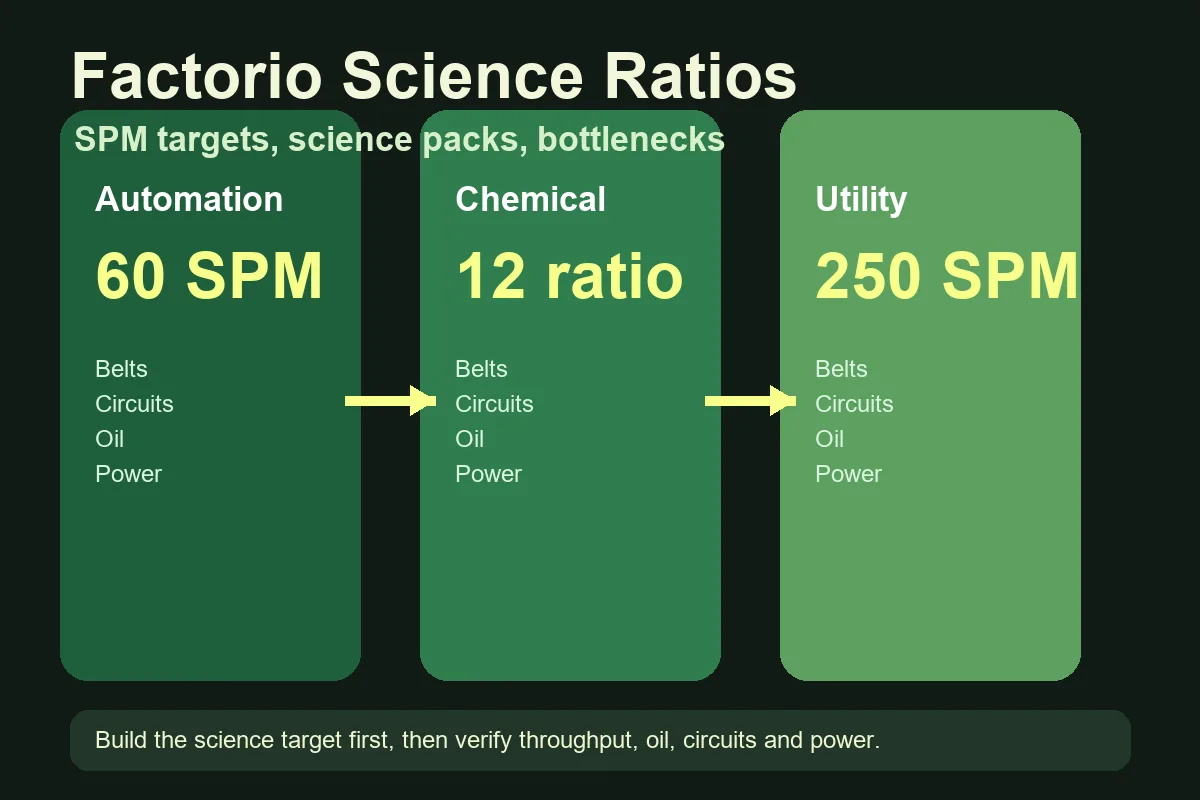
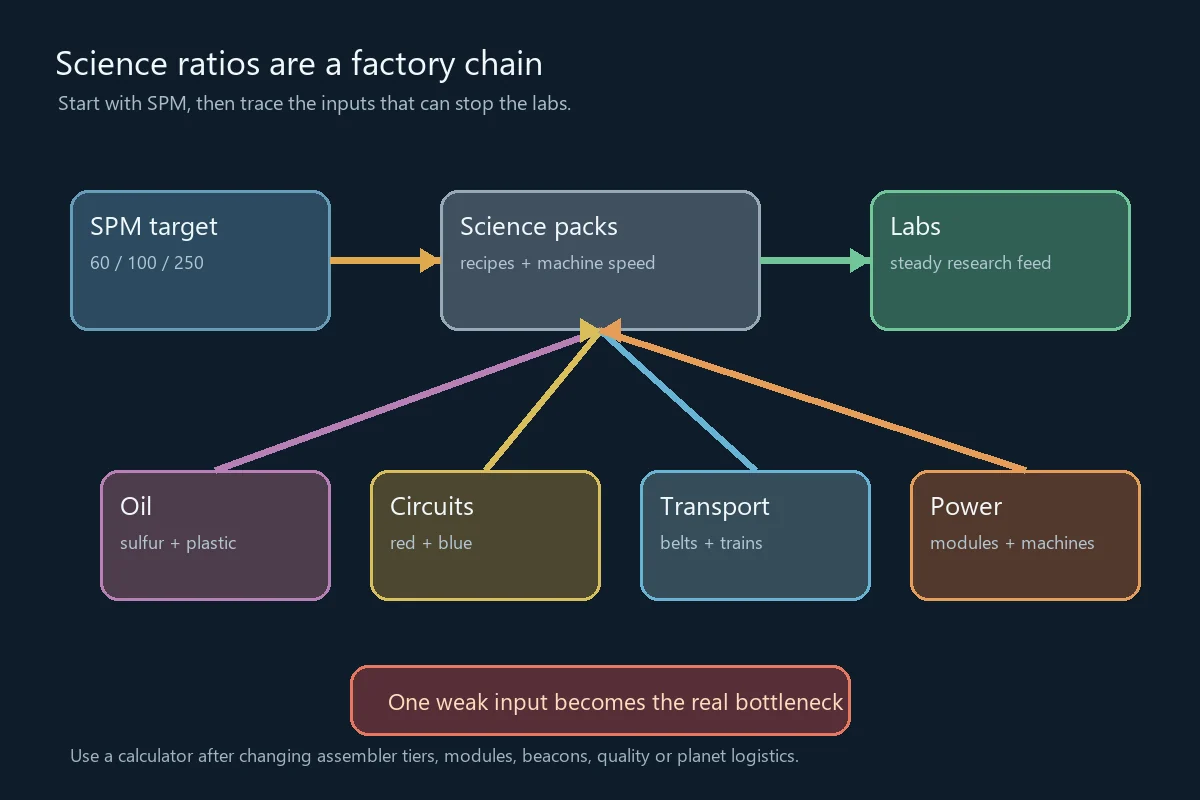
Ein Wissenschaftsziel wirkt auf dem Papier einfach, aber jedes zusätzliche SPM vervielfacht den Bedarf in vorgelagerten Stufen. Eine fehlende Ölkette, ein Mangel an roten Schaltkreisen oder ein ausgelastetes Förderband kann die gesamte Versorgung der Labore unterbrechen, selbst wenn das endgültige Wissenschaftsverhältnis korrekt aussieht.
Beginne mit einem Wissenschaftsziel, nicht mit einem auswendig gelernten Verhältnis
Die richtige Planungsfrage lautet nicht nur „Wie ist das Verhältnis?“, sondern „Welche Forschungsgeschwindigkeit will ich dauerhaft aufrechterhalten?“ SPM ist der klarere Entscheidungspunkt, weil es dazu passt, wie Spieler die Größe ihrer Fabrik planen.
| Ziel | Typische Verwendung | Auswirkung auf die Planung |
|---|---|---|
| 60 SPM | Angenehmer Fortschritt in der Hauptbasis | Klein genug für saubere bandbasierte Layouts und einfache Fehlersuche. |
| 100-250 SPM | Strukturierte Skalierung im Mittel- und Endspiel | Öl, Schaltkreise, Bahnversorgung und Strom werden zu deutlicheren Engpässen. |
| 500-1000 SPM | Große optimierte Basis | Beaconing, Zugdurchsatz, UPS und Logistikdesign sind wichtiger als auswendig gelernte Verhältnisse. |
| Planetenspezifische SPM | Planung der Space Age-Erweiterung | Lokale Produktion und interplanetarer Transport können der eigentliche Engpass sein. |
Referenz für klassische Science-Pack-Verhältnisse
Für das klassische Wissenschaftsset vor Space Age ist unten ein gängiges synchronisiertes Assembler-Verhältnis aufgeführt. Es ist als Spickzettel nützlich, aber nur, solange die zugrunde liegenden Maschinenannahmen konsistent bleiben.
| Science Pack | Relatives Verhältnis | Was normalerweise zuerst zum Engpass wird |
|---|---|---|
| Automation science | 5 | Normalerweise einfach; gears und copper sind unkompliziert. |
| Logistic science | 6 | Inserter und belts erhöhen früh den Druck auf Eisen. |
| Militärwissenschaft | 5 | Granaten, Mauern und panzerbrechende Munition können das Timing verschieben. |
| Chemiewissenschaft | 12 | Ölverarbeitung sowie der Aufbau von Schwefel und Plastik bremsen den Fortschritt meist aus. |
| Produktionswissenschaft | 7 | Schienen, Öfen und Produktivitätsmodule erhöhen den Materialbedarf deutlich. |
| Nutzwissenschaft | 7 | Blaue Schaltkreise, LDS und flying robot frames belasten mehrere Systeme gleichzeitig. |
Beispiel für das Verhältnis der grünen Wissenschaft bei 60 SPM
Für eine konkrete Prüfung der Logistikwissenschaft gilt: 60 SPM entsprechen einem grünen Wissenschaftspaket pro Sekunde. Mit assembling machine 2 und ohne Module benötigt das Rezept mit sechs Sekunden acht Endmontageanlagen; diese Anlagen brauchen zusammen außerdem pro Sekunde einen inserter und ein transport belt.
| Planungsschritt | 60-SPM-Ziel | Was zu prüfen ist |
|---|---|---|
| Ausgabe der Endpakete | 1 Logistikforschungspaket/s | Verwende die effektive Fertigungsgeschwindigkeit der gewählten Montageanlagen-Stufe. |
| Endmontageanlagen | 8 assembling machine 2 | Nach Modulen, Beacons oder gemischten Maschinenstufen neu berechnen. |
| Direkte Zutaten | 1 inserter/s und 1 transport belt/s | Prüfe die gemeinsame Versorgung mit Zahnrädern und Eisen, bevor du den Block übernimmst. |
| Transport-Spielraum | Mehr als der exakte Durchschnitt | Engpässe entstehen oft durch sprunghafte Mall-Nachfrage oder ungleichmäßige Bandbeladung. |
Empfohlener SPM-Planungsablauf
Ein SPM-Ziel festlegen
Lege vor dem Platzieren von Maschinen ein klares Ziel wie 60, 120 oder 250 Science pro Minute fest.
Science in vorgelagerte Systeme aufteilen
Trenne Schmelzen, Schaltkreise, Oil, low density structures, robot frames und Module, damit die tatsächlichen Engpässe sichtbar werden.
Maschinenanzahl und Crafting-Geschwindigkeit prüfen
Assembler-Stufe und Modulauswahl können den Science-Ausstoß so stark verändern, dass eine statische Tabelle ungenau wird.
Bänder, Rohre und Züge prüfen
Viele Science-Designs scheitern, weil Durchsatz und Lieferung hinter der sauberen Rezept-Mathematik zurückbleiben.
Nach dem Hinzufügen von Modulen oder Space Age-Systemen neu berechnen
Produktivität, Beacons, Qualität und interplanetarer Transport verändern den effektiven Science-Plan.
Wo Science-Basen normalerweise scheitern
Zu wenig Oil-Ausbau
Chemical science, blue circuits und späte Packs scheitern oft daran, dass Raffinerien, Cracking und Petroleum-Versorgung zu klein dimensioniert sind.
Schaltkreis-Engpässe
Red und blue circuits werden zu gemeinsamen Abhängigkeiten über mehrere Packs und Infrastrukturebenen hinweg.
Transportsättigung
Ein korrektes Science-Verhältnis scheitert trotzdem, wenn Bänder, Züge, Inserter oder Bots den Item-Fluss nicht aufrechterhalten können.
Leistungsverzug
Science-Erweiterungen sehen oft korrekt aus, bis Module, Roboports und Schmelzen das Stromnetz in Unterspannung bringen.
Beispiele für frühe Science Packs
Die Suchnachfrage umfasst green science ratios und red science ratios. Behalte diese Beispiele auf dieser Wissenschaftsseite, weil sie die SPM-Planung unterstützen, statt eigene Seiten zu benötigen.
| Pack | Hinweis für die Anfangsplanung | Wann neu berechnen |
|---|---|---|
| Automation science | Einfach genug, um es anhand von Zahnrädern und Kupferplatten zu dimensionieren. | Wenn sich Assembler-Stufen oder Module unterscheiden. |
| Logistik-/grüne Wissenschaft | Fließbänder und Greifarme erhöhen früh den Eisendruck. | Wenn die Fließbandproduktion auch eine Mall oder Erweiterung versorgt. |
| Military science | Granaten und Munition können ein sauberes Verhältnis stören. | Wenn der Verteidigungsbedarf dieselben Zutaten nutzt. |
| Chemical science | Der Ölaufbau wird normalerweise zum eigentlichen Engpass. | Wenn sich Petroleum, Schwefel oder Plastik stauen. |
Space Age-Wissenschaftsverhältnisse brauchen mehr als statische Tabellen
Space Age verändert die Wissenschaftsplanung, weil die Frage nicht mehr nur lautet, wie viele Assembler jedes Pack herstellen. Planetenspezifische Rezepte, der Takt der Logistik, Qualitätsentscheidungen und die Versorgung der Plattform können das effektive Verhältnis neu bestimmen.
| Space Age-Faktor | Warum er die Wissenschaftsberechnung verändert | Bessere Planungsgewohnheit |
|---|---|---|
| Planetenspezifische Rezepte | Jede Wissenschaftskette kann von einer anderen Produktionsumgebung abhängen. | Löse zuerst die lokale Kette und füge dann den Transport hinzu. |
| Cargo-Raketen und Plattformen | Der Lieferzeitpunkt kann die Wissenschaft begrenzen, bevor es der Rezeptausstoß tut. | Wandle den Bedarf an Packs in eine Versandkadenz um. |
| Qualitätsmodule | Wahrscheinlichkeitsbasierte Ausgaben verändern den Bedarf an Maschinen. | Plane Qualitätsziele getrennt von der grundlegenden Wissenschaft. |
| Leistungsunterschiede | Schwache oder instabile Stromversorgung kann eine komplette Wissenschaftskette ausbremsen. | Prüfe die lokale Stromversorgung, bevor du Labs hochskalierst. |
Brauchst du genaue Maschinenanzahlen für Wissenschaft?
Nutze den Live-Factorio-Rechner, um SPM-Ziele in Assembler, Eingänge, Bänder, Module und Strombedarf zu übersetzen, und nutze dann diese Seite, um die Schwachstellen gegenzuprüfen.
Häufige Fragen zu Factorio-Wissenschaftsverhältnissen
Was ist das klassische Wissenschaftsverhältnis in Factorio?
Eine gängige klassische Referenz ist 5:6:5:12:7:7 für Automation Science, Logistic Science, Military Science, Chemical Science, Production Science und Utility Science. Sieh es als schnelle Orientierung, nicht als universell exakten Bauplan.
Sollte ich Wissenschaft nach Verhältnissen oder nach SPM planen?
Plane zuerst nach SPM. Verhältnisse helfen dabei, Zusammenhänge zu erklären, aber Wissenschaft pro Minute ist das klarere Bauziel für Maschinen, Transport und Stromversorgung.
Warum stockt mein Wissenschaftsaufbau, obwohl das Verhältnis korrekt aussieht?
Die üblichen Ursachen sind Ölmangel, Engpässe bei roten oder blauen Schaltkreisen, ausgelastete Fließbänder, Zugverspätungen, unzureichende Stromversorgung oder Moduländerungen, die nicht neu berechnet wurden.
Verändern Module die Wissenschaftsverhältnisse in Factorio?
Ja. Produktivitätsmodule, Geschwindigkeitsmodule und Beacon-Effekte verändern den effektiven Ausstoß und den Zutatenbedarf, daher sollten die Maschinenanzahlen neu berechnet werden.
Verändert Space Age die Planung von Wissenschaftsverhältnissen?
Ja. Space Age fügt Planeten, Logistikrhythmen, Qualitätssysteme und neue Abhängigkeiten hinzu, sodass eine statische Wissenschaftstabelle nur noch ein Ausgangspunkt ist.
Wie ist das Verhältnis für grüne Wissenschaft in Factorio?
Grüne Wissenschaft hängt von der Versorgung mit Greifarmen und Fließbändern ab, daher ist die nützliche Planungsantwort nicht nur eine endgültige Anzahl an Montageanlagen. Dimensioniere logistische Wissenschaft von deinem SPM-Ziel aus und prüfe dann, ob Eisenplatten, Zahnräder und die Fließbandproduktion zusätzlich auch eine Mall oder Erweiterung versorgen.
Wie viele Montageanlagen brauche ich für 60 SPM grüne Wissenschaft?
Mit Montagemaschine 2, dem normalen Sechs-Sekunden-Rezept für logistische Wissenschaft und ohne Module verwendest du acht endgültige Montageanlagen für 60 Wissenschaft pro Minute. Rechne neu, wenn sich Fertigungsgeschwindigkeit, Produktivität, Rezeptverhalten oder die Logistik in Space Age ändern und damit die Annahmen verändern.
Wie lautet das Verhältnis für blaue Wissenschaft in Factorio?
Es hängt vom SPM-Ziel und der Assemblerstufe ab, daher gibt es keine universelle Maschinenzahl. Starte mit blauer Wissenschaft pro Minute, berechne Schwefel, Motoren und rote Schaltkreise und prüfe anschließend Ölversorgung und Bandkapazität.
Wie berechne ich Factorio-Science-Verhältnisse für ein Ziel von 60 SPM?
Setze 60 Science pro Minute als Ziel, berechne die Assembler für die finalen Packs und verfolge jedes Rezept bis zu Laboren, Gurten, Öl, Schaltkreisen und Strom. Die genaue Zahl hängt von Rezeptversion, Maschinenstufe, Modulen, Beacons und der Space-Age-Logistik ab.
Quellen und weiterführende Informationen
Diese Referenzen helfen dabei, Daten zu Wissenschaftspaketen, Rezeptbeziehungen und das Verhalten des Rechners zu überprüfen.